Level 4 · Roles · Practitioner
AI in Marketing: Five Workflows That Keep Your Claims Honest
AI in marketing means using AI tools to plan, draft, repurpose and measure marketing work, with people deciding what's true and what goes out. Most of the time it saves comes from the brief before the writing and the report after it. The risk is in the claims: AI will happily invent a statistic or a customer result. Below are five workflows with prompts, and the checks to run before anything is published.
In 30 seconds
- Write a short brand context file first: who you sell to, what you can prove, how you sound and the words you never use.
- Hand AI the brief, the first draft, repurposing and the report summary. Keep strategy, final claims and taste with people.
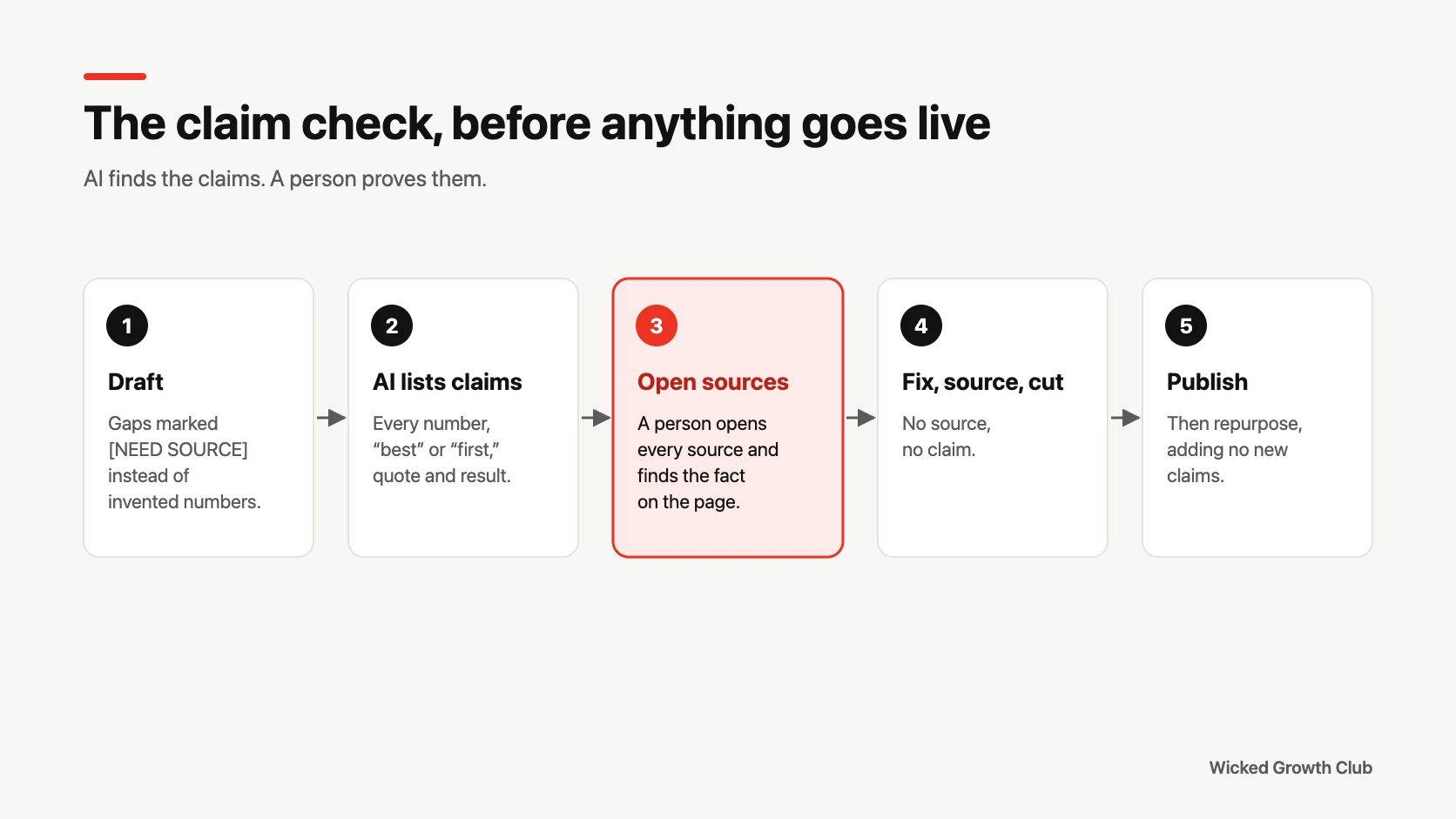
- Before anything goes live, someone opens the source for every claim. AI makes up numbers, quotes and results and states them calmly.
- The FTC's 2024 rule bans fake reviews and testimonials, AI written ones included.
- Google doesn't penalize content for using AI. It does treat mass produced pages made to game rankings as spam.
What AI in marketing looks like day to day
On most teams, AI use has spread one person at a time. One marketer's drafts are good; another's read like a press release about nothing; nobody can say which facts were checked. The fix is boring and it works: agree on one tool, one context file, a shared set of prompts and one review step.
Scroll sideways to see the whole table.
| Task | Hand to AI | Keep with people |
|---|---|---|
| Planning | Turning notes into a structured brief; listing what the brief leaves open | Choosing the audience, the offer and the goal |
| Writing | First drafts, headline options, shorter and longer versions | The angle, the final claims, what you'd put your name to |
| Repurposing | Turning one article into posts, an email and a script | Deciding what's worth repeating, and where |
| Research | Summarizing pages and reviews you supply; spotting themes | Deciding what's true and what matters |
| Reporting | Summarizing exports; drafting the "so what" | Deciding what to change and what to stop |
Set up: the brand context file
Without context, AI writes the most average version of whatever you ask for. A context file of one or two pages, saved where everyone's AI chats can reach it, fixes most of that.
Prompt
Draft your brand context file from what you already have
I'll paste our homepage copy, our best performing email and two pieces of content we're proud of: [paste them].
Draft a brand context file under 500 words with these sections: (1) who we sell to and what they're trying to get done, (2) what we offer, in one sentence, (3) proof we can actually use, ONLY from what I pasted, (4) how we sound, with three example sentences in our voice, (5) words and phrases we never use, (6) claims we never make. Mark anything you inferred rather than read as INFERRED so I can check it.
Then edit it by hand. Spend most of your time on "proof we can actually use" and "claims we never make," since those two sections are what keep the AI from inventing results. Sales teams use the same idea; see How to Build a Seller Context File.
How to use AI in marketing: five workflows
Workflow 1: Better briefs
A vague brief produces a vague draft no matter who writes it. Have AI poke holes in the brief before anyone starts writing.
Prompt
Turn rough notes into a brief, and find the gaps
Using our brand context file, turn these notes into a one page content brief: [paste notes].
Sections: audience, the one thing they should believe after reading, the action we want, key points, proof we'll use (only from the context file or sources I give you), format and length, and where it will be published. Then list the five most important questions this brief doesn't answer yet.
Workflow 2: First drafts in your voice
Before
Write a blog post about why finance teams should automate invoice processing.
A typical result: 800 smooth words that say little, two statistics with no source, and a last line about "unlocking efficiency."
After
Using our brand context file and the brief below, write a first draft.
Brief: [paste the brief].
Rules: use only the proof in the brief and the context file. If a point needs a fact we don't have, write [NEED SOURCE] instead of a number. Match the three example sentences in the context file. No phrases from the "never use" list. Under 900 words.
A typical result: a draft that sounds like you, with the missing facts marked so someone can find real ones.
The [NEED SOURCE] marker matters because it turns a made up number into a visible blank that someone has to fill.
Workflow 3: One piece, many formats
Prompt
Repurpose one approved article
Here is an approved article: [paste it]. Using only facts and claims already in it, create: (1) three social posts under 60 words each, each with a different angle, (2) a 120 word email to our newsletter, (3) a 45 second video script with a spoken opening line. Don't add any new facts, numbers or claims. Keep our voice from the brand context file.Keep the "only facts already in it" line. New, unchecked claims tend to slip in during repurposing, because a single social post feels too small to bother checking.
Workflow 4: Reports into decisions
Prompt
Turn a campaign export into a short decision memo
Here's last month's campaign export as a table: [paste or attach; remove any customer personal data first].
Write a half page memo: (1) the three things that changed most compared with the month before, with the numbers, (2) one possible reason for each, labeled as a guess, (3) one thing to try next month and one thing to stop. Show your math for every number you calculate so I can check it.
Recheck at least one number yourself. AI can misread a column or add wrong, and people tend to trust a memo that looks finished.
Workflow 5: The claim check
Run this on every piece before it's published.
Prompt
Find every claim that needs a source
Read this draft: [paste it]. List every factual claim: numbers, comparisons, "best" or "first" statements, customer results, quotes and anything about competitors. For each, say whether the draft gives a source. Mark any claim without one as NEEDS SOURCE. Don't judge whether claims are true; just find them.Then a person opens every source. A link the AI supplied proves nothing until you've clicked it and found the fact on the page. When AI states something false with confidence, that's called a hallucination.
A week on Tallyline's marketing team (a fictional company we use across our guides; it sells invoice automation to finance teams)
- Monday. The content lead turns notes from sales calls into a brief. The AI lists five open questions, and two of them (which industries, and which proof) change the angle.
- Tuesday. The first draft comes back with three
[NEED SOURCE]markers. The writer fills two with numbers from Tallyline's approved case study and drops the third point. - Wednesday. The claim check flags "the fastest way to close the books." Nobody can back up "fastest," so it becomes "a faster way."
- Thursday. The approved article becomes three posts and an email, with no new claims added.
- Friday. The monthly memo says email signups jumped. The manager rechecks the number, finds a duplicated row, and the real increase turns out to be half as big.
Reviews, search and ownership: the rules
Don't generate reviews or testimonials. The FTC's final rule on fake reviews and testimonials, announced in August 2024, bans fake reviews and testimonials, including AI generated ones that don't come from a real customer's real experience, and lets the FTC seek civil penalties. Helping a real customer tidy up their own words is a separate question; ask your legal owner before you do it.
Google cares about quality, not the tool. Google says it rewards helpful, original content however it's produced. Its spam policies treat scaled content abuse, meaning many pages made mainly to manipulate rankings, as spam whether a person or AI made them. Fewer pages that only your team could have written will do better.
Content made entirely by AI may not be protectable. The US Copyright Office's January 2025 report on copyrightability concluded that prompts alone don't make you the author of AI output. Human creative choices, edits and arrangement can still be protected, which is one more reason to edit properly.
A 30 day plan for your team
Week 1: agree on the basics
Write the brand context file together. Agree on the approved AI tool and the data rules.
Week 2: share the prompts
Save the five prompts on this page as prompt templates in one shared place. How to Build a Shared AI Prompt Library covers how to keep them up to date.
Week 3: make the claim check routine
Nothing goes live without it. The manager spot checks two pieces.
Week 4: look back
Which pieces took less time? Which needed the most fixing? Add what you learned to the context file.
Try it now
20 minutes, on a real piece of work
- Take a draft your team is about to publish.
- Run the claim check prompt in your company approved AI tool.
- Open the source for every flagged claim, then fix it, add a source or cut it.
- Count the claims that had no source. That's the number to bring down.
Key idea
AI can write the first draft. Your team still answers for every claim in the final one.
FAQ
What is AI in marketing?
AI in marketing is the use of AI tools to help plan, write, repurpose and analyze marketing work: drafting briefs and copy, turning one piece into several formats, summarizing research and reports. People still set the strategy, choose the claims and approve what's published.
How do you use AI in marketing?
Start with a shared brand context file, one approved AI tool and a rule that every claim has a source before it's published. Then pick one workflow, such as briefs or repurposing, and make it a team habit before adding the next.
Does Google penalize AI generated content?
Not for using AI. Google says it rewards helpful, original content however it's made. Mass produced pages made mainly to manipulate rankings count as spam, whether a person or AI produced them.
Can we use AI to write customer reviews or testimonials?
No. The FTC's 2024 rule bans fake reviews and testimonials, including AI made ones that don't reflect a real customer's experience, and allows civil penalties. Collect real reviews from real customers.
How do we keep AI content in our brand voice?
Give the AI three to five samples of your real writing, a list of words you never use and a short description of your audience. Then do a second editing pass for anything that could appear on a competitor's site.
Is there AI training for marketing teams?
Yes. Wicked Growth Club members get a marketing route with practice on their own real work, and teams can join together. Whatever you choose, look for training built around your real work that teaches people to check the output.
AI for Sales Certification
Give your marketing team one way of working with AI
10 self paced sessions, recorded walkthrough videos and a graded capstone, all practiced on your own accounts. Membership is $50 a month. Add the $350 certification when you're ready.
Not sure where to start? Take the 2 minute assessment